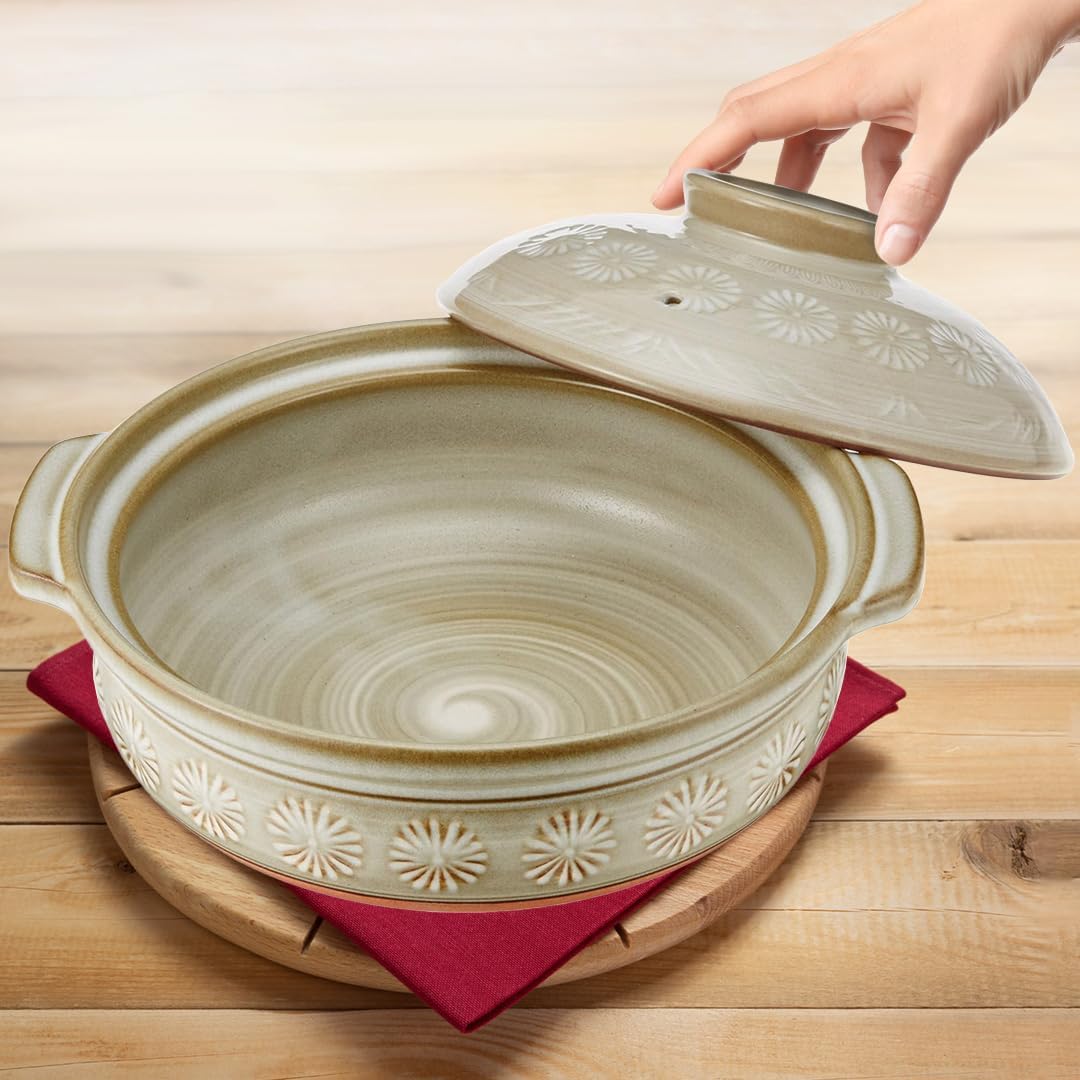
A donabe (pronounced doh-nah-beh) is a Japanese clay cooking pot — the rough translation is simply “earthen pot” — and it has been at the center of Japanese home cooking for more than a thousand years. Think of it as the Japanese counterpart to a French cocotte or a Moroccan tagine: a vessel whose porous, heat-retaining walls do something fundamentally different from metal cookware. Where stainless steel heats fast and aggressively, donabe heats slowly and evenly, then holds that warmth long after you’ve taken it off the flame. The result is rice with a gentle crust at the bottom (okoge), braises that taste like they’ve been going for hours, and hot-pot meals that stay at temperature across an entire leisurely dinner.
If you’re reading this, you’ve probably moved past “what is a donabe” and are now staring down a real decision: which one, what size, will it work on your cooktop, and is the price premium on certain regional pieces actually justified? This guide answers those questions directly, with tradeoffs named and math shown.
Sizing: The One Decision That’s Hardest to Undo
Donabe are sized by the number of go (合) of rice they cook, but retailers almost universally translate this into serving counts, so that’s the more useful frame. The standard range looks like this:
| Size label | Typical diameter | Best for |
|---|---|---|
| 2–3 serving | ~22–24 cm | 1–2 people, small-batch rice |
| 4–5 serving | ~26–28 cm | Families of 3–4, nabe hot-pot |
| 6–8 serving | ~30–33 cm | Large family meals, entertaining |
The instinct is almost always to buy one size too small. Owners across aggregated reviews consistently flag this: a 2–3 serving pot feels right for a couple until you want to make a full nabe dinner with multiple proteins and vegetables, at which point you need the 4–5 serving minimum. Toiro Life’s education pages on donabe selection specifically recommend sizing up by one tier if hot-pot meals (nabe ryori) are part of your intended use, because those dishes need head space for broth and ingredients beyond the rice line.
The tradeoff: larger pots are heavier, take longer to reach cooking temperature, and are harder to store. A 30 cm donabe can weigh 3–4 kg empty. If your primary use is weeknight rice for two people and storage is tight, the 22–24 cm range is genuinely the right call — don’t over-engineer this.
If X, then Y:
- Primarily solo or couples’ rice cooking → 22–24 cm
- Mixed use (rice + occasional hot-pot for 2–4) → 26–28 cm is the workhorse size
- You host regularly or have a family of 4+ → 28–30 cm, no hesitation
Induction Compatibility: The Honest Breakdown
This is the most common pain point in donabe ownership, and the answer is less simple than the product listings sometimes make it sound.
Traditional donabe are not induction-compatible. Induction cooktops work by creating a magnetic field that heats ferrous (iron-containing) metal directly. Clay contains no iron, so a standard donabe sitting on an induction burner simply won’t heat up. This catches buyers off guard because the pots look heavy and “substantial” in a way that suggests they’d work on anything.
There are two real solutions, each with meaningful tradeoffs:
Option 1: Donabe with an iron-powder base layer. Several manufacturers — most notably Nagatani-en (based in Iga, Mie Prefecture) and some Banko ware producers — embed iron particles into the clay of the base during the firing process, allowing the pot to register on induction cooktops. These work, but owners and reviewers on Food & Wine’s donabe roundup note that performance is more variable than on gas: heat distribution can be slightly less even across the bottom, and you need a flat-bottomed induction burner rather than a portable IH unit to get reliable results. The pots also tend to cost 15–25% more than their non-induction equivalents.
Option 2: IH interface disk (tetsu no ban). A cast-iron heat diffuser disk placed between the induction cooktop and a standard donabe transfers heat from the magnetized metal to the clay. Saveur’s feature on donabe cooking mentions this as a legitimate workaround favored by Japanese home cooks who already own traditional pots. The disk adds $20–$40 to your total cost and one more thing to wash, but it preserves the thermal characteristics of a pure clay pot and gives you more flexibility in which donabe you buy. Owners report that you need to preheat the disk first and manage heat more attentively, since you’re now working with two layers of thermal mass.
The honest math: if you cook exclusively on induction and want a frictionless experience, buy a purpose-built induction donabe from a maker like Nagatani-en and pay the premium. If you already own a beautiful traditional donabe or are buying primarily for gas with occasional induction use, the interface disk is the better economic call.
If X, then Y:
- Induction-only kitchen, want zero fuss → induction-rated donabe, budget $120–$250+ for a reputable piece
- Gas or mixed kitchen → any traditional donabe; the world opens up considerably
- Already own a traditional donabe and just acquired an induction cooktop → interface disk first, upgrade later if the friction is real
Why Banko Ware Is Worth Seeking Out
Japan has several regional ceramic traditions that produce donabe, and Iga ware (from Mie Prefecture) gets most of the international attention — deservedly, since Iga clay’s high porosity and volcanic mineral content genuinely perform well at heat. But practitioners who’ve moved past the entry-level decision and are looking at their second or third donabe should know about Banko ware (Banko-yaki, from Yokkaichi, Mie Prefecture, about 60 km from Iga).
Banko ware has been produced in the Yokkaichi region since the mid-Edo period (roughly the 1700s), and what distinguishes it technically is the clay body: Banko clay has a naturally lower thermal expansion rate than many other Japanese ceramics. In plain terms, this means Banko donabe are less prone to thermal shock — the cracking or crazing that can occur when a cold pot meets high, sudden heat. The Japan Times has reported on the Mie Prefecture ceramic belt, noting that Banko kilns have historically specialized in cookware precisely because of this durability characteristic, and that the tradition produces both everyday utilitarian pieces and refined decorative work within the same regional lineage.
What this means practically:
Toiro Life, the specialist US retailer that has done more than anyone to introduce quality donabe to American home cooks, carries a deep selection of Banko pieces and specifically notes in their product education that Banko ware’s thermal stability makes it well-suited to a wider range of stovetop conditions. Owners consistently report that Banko pots require less anxious “seasoning” attention and are more forgiving of the inevitable beginner error of placing a recently refrigerated pot on a warm burner.
Banko ware also tends toward a lighter, thinner profile than Iga ware. A Banko 4–5 serving donabe might come in at 1–1.5 kg lighter than a comparable Iga piece. That matters for daily use — lifting a heavy pot of boiling broth is a practical consideration, not an aesthetic one.
The tradeoff: Iga ware’s thicker walls mean it retains heat slightly longer once it’s up to temperature, which matters for dishes like taki-komi gohan (seasoned rice) that benefit from a long, gentle finishing steam with the heat off. If maximum heat retention is your primary criterion, Iga is the traditional choice. If durability, lighter handling, and a slightly wider cooktop compatibility range matter more, Banko is genuinely the smarter purchase for most home cooks.
The Numbers You Actually Need
By the numbers — donabe price and size orientation (2025–2026 market):
- Entry Banko or generic donabe, 2–3 serving: $40–$80
- Mid-range Banko ware (Yokkaichi production), 4–5 serving: $90–$160
- Nagatani-en Iga ware, induction-compatible, 4–5 serving: $150–$280
- Premium hand-finished Iga or Banko (Toiro-stocked, limited makers): $300–$600+
The gap between entry and mid-range is meaningful. Across aggregated reviews, the pattern is clear: sub-$60 donabe from unattributed makers fail at the lid seal (steam escapes rather than recirculates, degrading rice texture) and show more thermal crazing over time. The $90–$160 Banko sweet spot is where provenance-verified craft and everyday durability converge.
Making the Decision
Here’s the decision frame, consolidated:
If you’re buying your first serious donabe: a 26–28 cm Banko ware piece in the $100–$160 range is the recommendation that holds up across nearly every use case. It’s the right size, it’s forgiving, it comes from an identifiable craft tradition you can actually read about and connect to, and it doesn’t lock you into a single heat source.
If you’re adding a second pot: consider sizing up to the 4–5 or 6-serving range in Iga ware if you host regularly and want the maximum heat-retention performance for show-stopping nabe dinners. The thermal mass difference is real at that scale.
If you’re on induction: budget for the premium on a purpose-built induction-rated pot, or buy a quality traditional piece plus a cast-iron interface disk. Either path works; the disk path gives you a better pot for the same total spend.
If you’re gift-giving: a mid-range Banko piece at $120–$150 hits the sweet spot between “meaningful and provenance-rich” and “not so precious that someone’s afraid to use it.” Pair it with a short note about Yokkaichi and its ceramic lineage — that story is half the gift.
The donabe you use twice a week for a decade is worth more than the one you admire on a shelf. Buy for your actual cooktop, size up one tier from your instinct, and let the clay do what a thousand years of Japanese kitchen tradition has refined it to do.