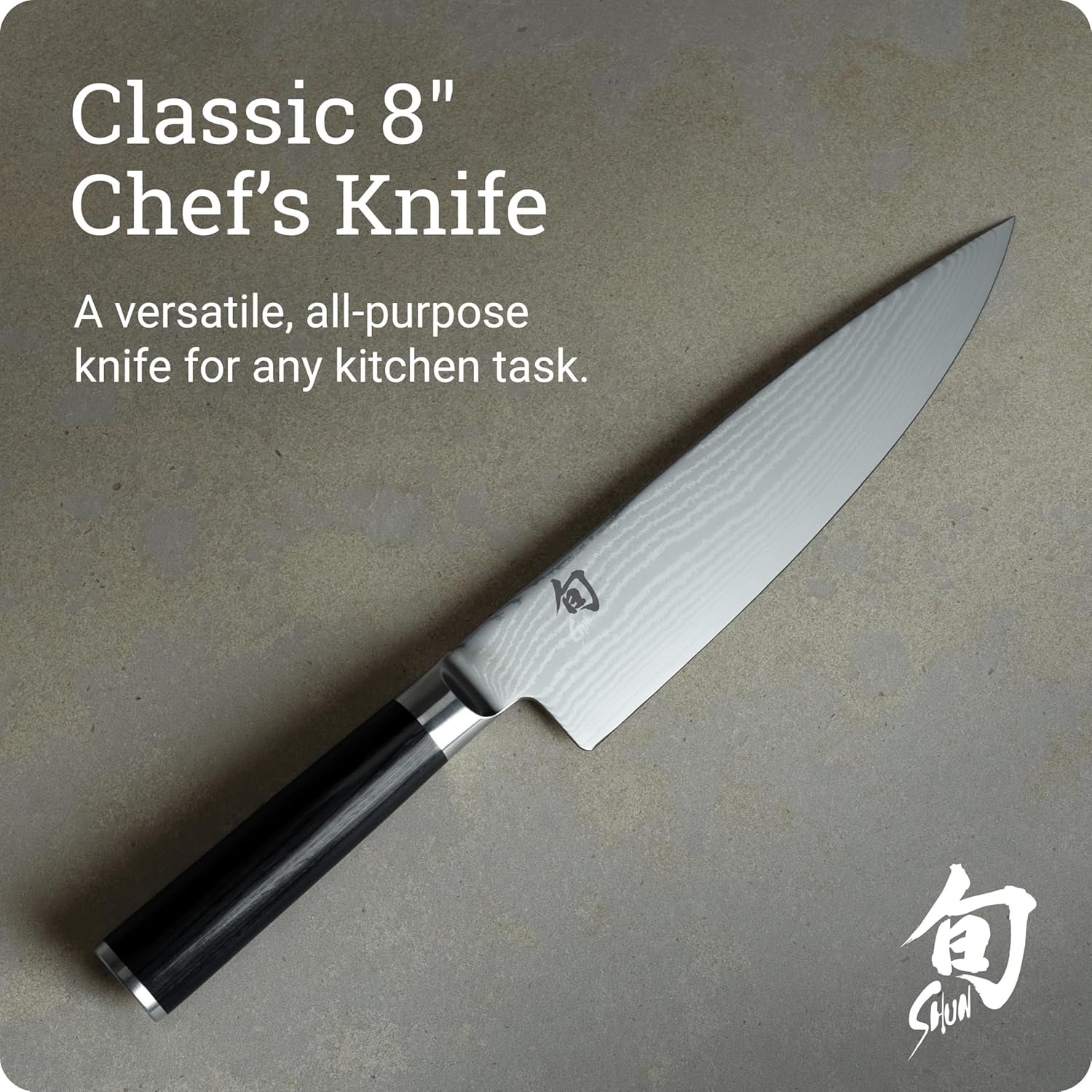
A gyuto (pronounced “gyoo-toh”) is Japan’s answer to the Western chef’s knife — a long, slightly curved, double-beveled blade designed to handle almost everything in your kitchen, from breaking down a whole chicken to slicing paper-thin daikon. If you’re shopping for one, you’ve almost certainly bumped into three steel names: VG-10, SG2, and AUS-10. These are the grades of stainless steel — the alloy recipe, essentially — that determines how sharp a blade gets, how long it stays that way, and how much patience you’ll need when it eventually asks to be sharpened. Choosing between them isn’t just a materials-science exercise. It maps directly to how you cook, how often you sharpen, and how much you want to spend. This guide breaks down all three, shows you the real tradeoffs, and ends with a plain-language decision rule so you can stop second-guessing yourself.
| EDITOR'S PICKShun Premier 8" Chef's Knife | Mid-tierShun Classic 8" Chef's Knife | Budget pickShun Sora 8" Chef's Knife | |
|---|---|---|---|
| Steel Core | VG-MAX | VG-MAX | VG10 |
| Blade Finish | Damascus | Damascus | — |
| Handle Material | Pakkawood | Pakkawood | — |
| Price | $219.95 | $159.00 | $109.95 |
| See on Amazon → | See on Amazon → | See on Amazon → |
What the Steel Numbers Actually Mean
Before comparing, it helps to understand two properties that knife steel specs always revolve around: hardness and toughness.
Hardness (measured on the Rockwell C scale, abbreviated HRC) tells you how resistant the steel is to deformation. A harder steel holds an acute, razor-thin edge for longer. The tradeoff: harder steels are more brittle. Drop a hard knife on a tile floor, or wrench it sideways through a butternut squash, and you risk a chip rather than a bend.
Toughness is roughly the inverse — how well the steel absorbs impact without fracturing. A tougher steel is more forgiving but will require more frequent sharpening because its edge rolls rather than holds.
All three steels below are stainless (or near-stainless), meaning they contain enough chromium to resist rust under normal kitchen conditions. That’s worth naming because Japan’s traditional carbon steels — like the beloved Aogami (Blue Paper) and Shirogami (White Paper) — deliver extraordinary edge retention but demand dry storage, immediate cleaning, and a certain comfort with patina. Stainless steels trade a small slice of peak performance for dramatically lower maintenance. For most kitchens, that’s the right trade.
VG-10: The Workhorse Standard
VG-10 is produced by Takefu Special Steel in Echizen, Japan, and has been the backbone of mid-to-premium Japanese production knives for decades. The Japan Times’ reporting on Seki and Echizen knife-making traditions consistently identifies VG-10 as the steel that brought Japanese performance to a global audience at accessible price points.
Published specs: VG-10 typically finishes around 60–62 HRC depending on the maker’s heat treatment. It contains roughly 1% carbon, 15% chromium (solidly stainless), and notably, 1% cobalt — an addition that stabilizes the carbide structure and contributes to its reputation for holding a fine edge.
What owners report: Reviewers and long-term users across aggregated knife forums and published reviews consistently describe VG-10 as the steel that rewards a maintenance-minded cook without punishing an occasional one. It sharpens readily on whetstones from 1,000 to 6,000 grit, takes a keen edge, and — critically — doesn’t chip catastrophically if you hit a bone or slide it across a ceramic plate by accident. Serious Eats’ guide to best chef’s knives repeatedly positions VG-10 blades as top picks for cooks who want Japanese performance without the anxiety of owning a more brittle high-hardness knife.
Where you’ll find it: Tojiro DP (one of the best-reviewed entry-to-mid gyutos available, typically $80–$120), Shun Classic, and a wide range of Mcusta and Miyabi production lines. Shun Premier Damascus uses VG-10 at its core wrapped in Damascus-patterned steel — primarily aesthetic, but a legitimate use of the alloy.
The honest tradeoff: VG-10 is not the sharpest steel at its absolute peak, and it won’t stay sharp quite as long as the powdered steels below. If you’re a daily high-volume cook doing prep for four or more hours, you’ll feel the difference. If you’re a home cook or part-time private-dining host doing 45–90 minutes of active knife work at a stretch, VG-10 will impress you every time you use it.
SG2 (R2): The Enthusiast’s Upgrade
SG2 — also sold under the designation R2 depending on the manufacturer — is a powdered metallurgy steel made by Takefu Special Steel. “Powdered metallurgy” means the steel is formed from atomized powder rather than cast ingots, which produces an extraordinarily uniform carbide distribution throughout the blade. In plain terms: the hardness is consistent from edge to spine, which allows manufacturers to grind much thinner, more acute edges without introducing weak spots.
Published specs: SG2 typically reaches 62–65 HRC after heat treatment. Its carbon content runs higher (around 1.45%) and it includes vanadium — an element that forms hard carbides responsible for exceptional wear resistance.
What owners report: Knife Planet’s detailed comparison of VG-10 and SG2 characterizes the SG2 edge as noticeably more acute out of the box and meaningfully longer-lasting under sustained use. Owners in long-run reviews consistently note that SG2 knives perform at the top of their ability for weeks of regular home cooking before needing a touch-up on a strop. The flip side — and it’s worth saying plainly — is that SG2 is more brittle than VG-10. Reviewers frequently note that it requires more deliberate cutting technique: no twisting, no scraping, no hacking through frozen anything. The edge is thinner and harder, which means a sideways force that VG-10 would shrug off can chip SG2.
Sharpening is where SG2 earns its reputation as an enthusiast’s steel: it takes a stunning edge, but at 63+ HRC, it resists abrasion, including from your whetstone. You’ll want a diamond plate or a quality 1,000-grit stone to begin, and a fine finishing stone (6,000–8,000 grit) to polish. It’s not difficult, but it’s slower than sharpening VG-10 and rewards proper technique.
Where you’ll find it: Yoshihiro VG-10 and SG2 lines, Miyabi 5000MCD, MAC Professional MBK series, and select Takamura production knives — many in the $180–$400 range for a gyuto.
The honest tradeoff: You’re paying a meaningful premium (often $80–$150 more than a comparable VG-10 knife from the same maker) for longer edge retention and a more refined cutting feel. That math favors the serious home cook who prepares elaborate meals several times a week or the culinary professional who wants a personal knife that outperforms their workhorse line blades. If you sharpen on a schedule anyway and don’t mind touching up weekly, VG-10 closes the gap fast.
AUS-10: The Underestimated Option
AUS-10 is produced by Aichi Steel in Japan and sits in an interesting position: it’s often dismissed as a budget steel, but that reputation undersells it meaningfully for the right buyer.
Published specs: AUS-10 typically finishes at 60–62 HRC, almost identical to VG-10 on paper. It carries roughly 1.08% carbon, 13–14.5% chromium, and — like VG-10 — a small cobalt addition in some formulations. The key difference from VG-10 is that AUS-10 generally has a slightly lower vanadium content, which affects long-term wear resistance at the microscopic level.
What owners report: Saveur’s guide to Japanese kitchen knives describes AUS-10 as a practical, corrosion-resistant choice for everyday kitchen environments. Owners in aggregated reviews describe its edge behavior as very close to VG-10 — slightly more prone to micro-rolling under heavy use, but easy and forgiving to sharpen, especially for cooks still building their whetstone technique. Cook’s Illustrated testing reports have consistently noted that AUS-10 knives sharpen quickly on a 1,000-grit stone and return to a working edge with less effort than harder steels.
Where you’ll find it: AUS-10 shows up heavily in the $50–$150 price range from brands like Zelite Infinity and Findking, and in the entry lines of some larger Japanese producers. Dalstrong uses it across multiple lines. It’s not the steel of artisan bladesmiths, but it’s a legitimate, Japanese-made alloy with a real track record.
The honest tradeoff: AUS-10 is the right steel if you’re equipping a knife you plan to use hard, sharpen often, and not treat preciously. It’s excellent for a second gyuto kept at the office, a knife you share in a household where technique varies, or a first Japanese knife for someone still learning to maintain an edge. If you’re looking for the top of the performance range, it falls short of both VG-10 and SG2. But it costs less, forgives more, and — here’s the underrated part — it’s easier to learn to sharpen on, which matters enormously to long-term blade ownership.
By the Numbers
| Steel | Typical HRC | Edge Retention | Sharpening Ease | Brittleness Risk | Price Range (gyuto) |
|---|---|---|---|---|---|
| AUS-10 | 60–62 | Good | Easy | Low | $50–$150 |
| VG-10 | 60–62 | Very good | Moderate | Low–Medium | $80–$300 |
| SG2/R2 | 62–65 | Excellent | Moderate–Hard | Medium | $180–$500+ |
Hardness ratings based on published manufacturer and third-party metallurgical specs. Edge retention and sharpening ease reflect aggregated owner and reviewer reporting.
The Decision Rule
Here’s the clearest way to think about this:
If you cook enthusiastically 3–5 nights a week, own at least one whetstone, and want a gyuto that punches above its price class — VG-10 is your steel. A Tojiro DP or a Shun Classic gives you genuine Japanese craftsmanship, a blade that sharpens predictably, and forgiveness if your technique isn’t perfect. It’s the steel most professional kitchens start their personal knife collections with for good reason.
If you cook at a serious level, you’ve already owned a VG-10 knife, and you want to feel the difference an upgrade makes — SG2 is worth the premium. The edge is finer, the retention is real, and the performance gap over VG-10 shows up clearly in extended prep sessions. Buy it from a maker known for heat treatment consistency: Yoshihiro, Takamura, and Miyabi all have strong reputations here. Treat it with intention — dedicated cutting board, no twisting, proper storage — and it will reward you for years.
If you’re buying your first Japanese knife, sharing a knife with someone else, or want a solid blade you can sharpen aggressively without anxiety — AUS-10 won’t let you down. It’s the most honest entry point into the Japanese steel family, and the skills you build maintaining it transfer directly to higher-tier steels when you’re ready.
One last thing worth saying: the best knife steel is the one that matches how you actually cook today, not aspirationally. A VG-10 gyuto that gets sharpened regularly will outperform an SG2 blade that never sees a whetstone. Provenance and craft matter at SumoStore — and so does the honest truth that buying up doesn’t substitute for caring for what you own.