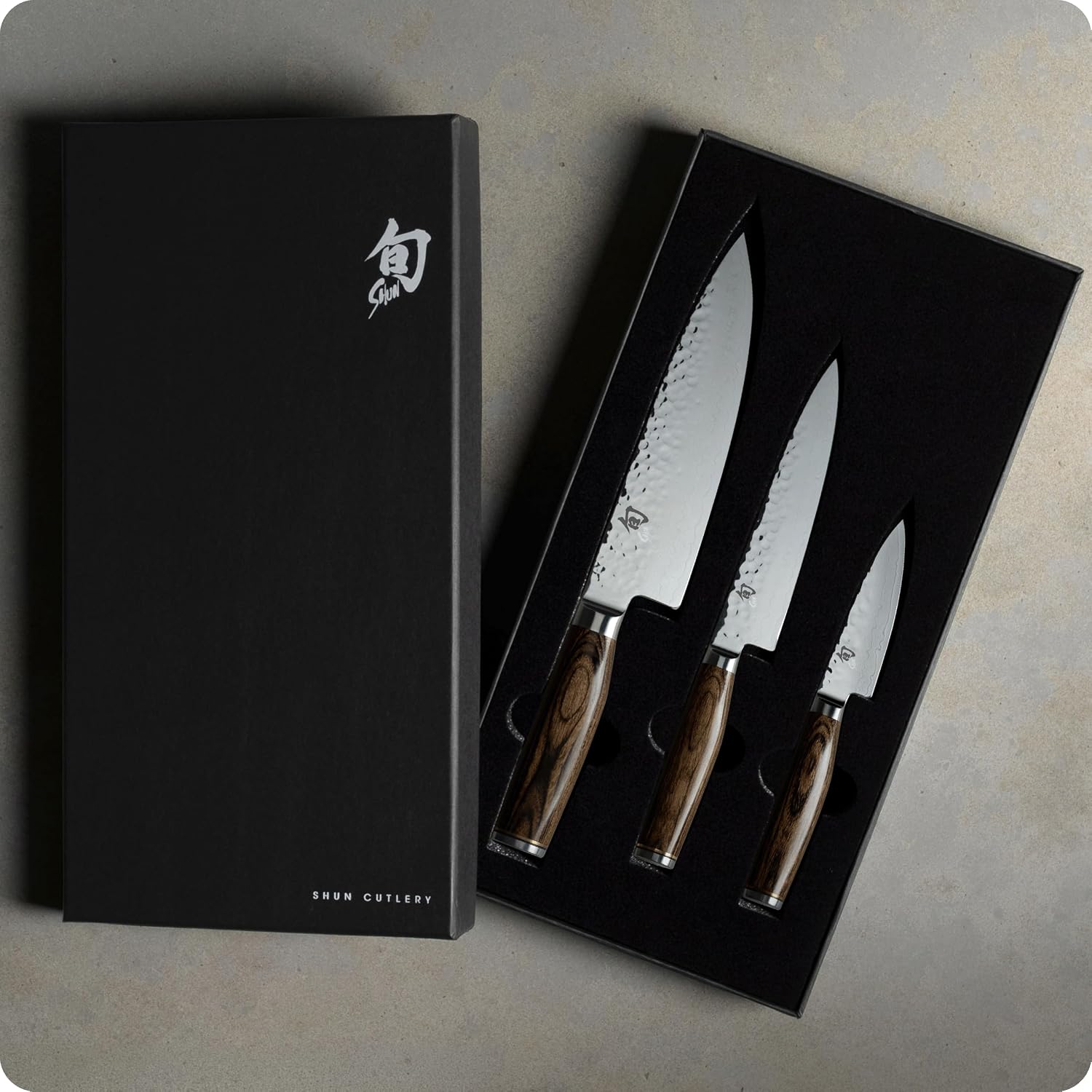
A knife block set sounds simple: a bundle of knives in a wooden holder, sold together at a better price than buying each piece separately. In practice, the category is a minefield. Most block sets on the market — including a surprising number marketed as “Japanese-style” — are assembled to hit a retail price point, not to reflect how a thoughtful cook actually works. The block ends up holding two knives you reach for daily and four you’ve never touched. Counter space is precious. So is your budget. This guide is built to help you evaluate whether a specific set is worth acquiring, and if so, which one fits how you actually cook. We’ll cover what to look for in steel, set composition, maker provenance, and honest price-to-value math across three spend tiers.
Why “Japanese” on the Label Isn’t Enough
The term Japanese knife covers an enormous range. At one end: hand-forged, single-bevel blades made by a named artisan in Sakai or Seki, finished with a traditional lacquered ho (magnolia wood) handle. At the other: stainless-clad knives manufactured at scale, branded with Japanese-sounding names, and assembled into sets with a generic block. Both can technically carry the label. The difference in performance, longevity, and cultural provenance is enormous.
A few definitions worth having before you evaluate any set:
Steel construction: Most Japanese knives use one of three formats. Monosteel (single alloy throughout) is honest and durable. San-mai or clad construction sandwiches a hard, high-carbon core between softer stainless outer layers — this gives you a thin, hard edge with a less-brittle spine, and it’s what most mid-range sets use. Damascus refers to a visible layered pattern on the blade, usually achieved through folding softer cladding — beautiful, but the pattern itself tells you nothing about the core steel’s quality.
HRC (Rockwell hardness): A number indicating how hard the steel is. Japanese knives typically run HRC 60–67; German knives run HRC 56–58. Harder steel holds an edge longer but chips more easily if you torque the blade or hit bone. Knowing the HRC helps you understand the care expectations — not just the marketing.
Wa vs. Yo handle: Wa-handle is the traditional Japanese octagonal or D-shaped wooden handle, typically lighter. Yo-handle is the Western-style full-tang handle. Sets aimed at the crossover market often mix both.
With those terms in hand, here’s how to think about set value at each tier.
The Tradeoffs by Price Tier
Entry-Mid: $150–$350
This is the most competitive band, and the most important to analyze carefully — because it’s where the worst value traps live alongside some genuinely excellent buys.
What you’re realistically getting: VG-10 stainless or similar mid-range steel, factory-ground edges, and a block that was probably designed in parallel with the knives rather than as an afterthought. Sets from Shun Cutlery (specifically the Shun Classic 6-Piece Block Set) and Miyabi (the Miyabi Kaizen series) show up repeatedly in this tier. Serious Eats’ knife roundup notes that VG-10 at HRC 60–61 is an honest workhorse steel — holds an edge well, sharpens without drama, handles the full range of home kitchen tasks.
The composition question: A six-piece set sounds comprehensive. But count what you’re actually getting. If the set includes a 3.5-inch paring knife, a 4.5-inch utility knife, a 7-inch santoku, an 8-inch chef’s knife, kitchen shears, and a honing rod — that’s two knives doing the real work and four supporting cast members. If you’re a practitioner who already owns a good paring knife, a set built around the paring slot is a worse deal than buying the chef’s knife and santoku individually.
Wirecutter’s knife guide has made this point consistently: the block itself often pads the perceived value. A $280 set where the block costs $40 to manufacture is a different buy than a $280 set where $220 went into two or three serious blades.
Decision rule for this tier: If you’re equipping a kitchen from near-zero, a Shun Classic or Miyabi Kaizen set is defensible. If you already have one or two solid knives, skip the set and spend the $250–$350 on a single better blade.
Mid-Tier: $350–$700
At this level, you start seeing meaningful differentiation in steel and in maker provenance — and the sets that understand their own identity are significantly better buys than the ones trying to be everything.
Yoshihiro’s entry into sets (the Yoshihiro VG-10 Hammered Damascus series, sold in 2–3 piece configurations with optional block) is worth examining here. Yoshihiro is a Sakai-based manufacturer with documented lineage in the bladesmithing tradition. KnifePlanet’s steel guide notes that their VG-10 core is layered under 46 layers of Damascus cladding — the pattern here is genuine hammered texture, not a printed cosmetic finish, which matters for both grip and aesthetics.
Tojiro’s DP series takes a different approach: plain-finished, no Damascus drama, a polished VG-10 core at HRC 60. Sets in this tier run $350–$500 for a 3–4 piece chef-focused collection. Saveur’s knife guide describes Tojiro DP as “reliable without romance” — which is a fair characterization and not a criticism. For a working kitchen or a culinary school graduate setting up their first serious kit, the lack of visual theater means the budget went into the steel and the grind.
By the numbers:
| Set | Steel | HRC | Knives Included | Block Included | Street Price (May 2026) |
|---|---|---|---|---|---|
| Shun Classic 6-Pc | VG-10 | 60–61 | 6 | Yes | ~$280–$320 |
| Tojiro DP 3-Pc | VG-10 | 60 | 3 | Optional | ~$200–$260 |
| Yoshihiro VG-10 Damascus 3-Pc | VG-10 (46-layer clad) | 61 | 3 | Optional | ~$350–$420 |
| Miyabi Birchwood 5-Pc | SG2 (MC63) | 63 | 5 | Yes | ~$600–$650 |
Decision rule for this tier: Yoshihiro for provenance and aesthetics; Tojiro DP for pure performance-per-dollar. If you’re buying for a working kitchen, the Tojiro math is hard to argue with. If you’re buying for a home kitchen where the knives will also be seen, the Yoshihiro’s hammered texture earns its premium.
Premium: $700–$1,500+
At this level, the conversation shifts from “is this a good set” to “does this set reflect a coherent philosophy about how to cook and what to own.”
Shun Premier Damascus sets (the 6–8 piece Premier collections, street price $700–$900) use a VG-MAX core — Shun’s proprietary alloy with marginally higher cobalt and carbon content than standard VG-10, rated at HRC 61. Food & Wine’s knife set coverage positions the Premier line as the best balance of performance and visual impact in the mass-premium tier. The tsuchime (hammered) finish reduces drag when cutting; owners consistently report noticeably cleaner slicing through dense vegetables compared to polished-finish blades of similar hardness.
Global’s G-Series deserves mention here even though it sits at a different aesthetic pole — all-steel construction, Western-ish handle geometry, Japanese steel. Sets run $600–$900 for 5–7 pieces. For a professional or semi-professional context where the knives go through a commercial dishwasher cycle (not recommended, but let’s be honest about how pro kitchens operate), the all-steel construction has durability advantages over wood-handled alternatives.
The Honyaki consideration: If your budget reaches $1,000+, you’re approaching territory where buying a single Yoshihiro Honyaki wa-gyuto makes more sense than any block set. Honyaki forging — single steel, no cladding, water-quenched — produces the best edge retention available in a kitchen knife. But it’s brittle, demands careful use, and requires a skilled sharpener. A $1,200 honyaki is not a set; it’s a singular object with a singular use case. Saveur’s Japanese knife guide describes honyaki as “the choice for the cook who already has everything else and wants the pinnacle.”
Decision rule for this tier: Shun Premier if you want a complete, cohesive set with strong aesthetic identity and proven long-run performance. Individual honyaki purchase if your fundamentals are already covered and you want to invest in a blade you’ll use for decades.
The Block Itself: An Underrated Variable
Most buyers evaluate the knives and treat the block as packaging. That’s a mistake.
A universal block (the kind with dozens of thin polymer rods that accept any blade size) is more versatile but can leave blades rattling slightly — over years of daily use, that micro-movement contributes to edge micro-chipping. Traditional slotted hardwood blocks are dimensionally specific to the knives they ship with, which means better blade security but no flexibility if you add a blade from a different maker.
Magnetic wall strips, which some premium sets now offer as a block alternative, eliminate the rattling problem entirely and are — per apartment therapy’s kitchen organization coverage — increasingly preferred by practitioners who want counter space back. If a set offers a magnetic strip instead of a block, that’s not a downgrade. It may be an upgrade.
The Provenance Check
Before finalizing any purchase decision, run a quick provenance check. The key questions:
-
Is the maker named? Shun (Kai Corporation, Seki City), Yoshihiro (Sakai, Osaka Prefecture), Tojiro (Tsubame-Sanjo region, Niigata). Named makers with documented geography are a better signal than “crafted in Japan by skilled artisans.”
-
Is the steel specified by name? VG-10, SG2/MC63, Blue Steel No. 2, White Steel No. 1 — these are real alloy designations with known properties. “High-carbon stainless” without a designation is a marketing placeholder.
-
Does the set include a knife you won’t use? A bread knife is useful in a home context; in a professional or serious home kitchen that already has one, it’s dead weight.
The Decision Frame
If you’re starting from scratch and want one cohesive investment: Shun Classic or Premier, depending on budget. Proven maker, honest steel spec, strong long-run review record across Wirecutter and Serious Eats.
If you want maximum blade value per dollar and don’t need the block: Tojiro DP individual pieces, assembled into your own kit over time.
If provenance and craft story matter as much as function: Yoshihiro VG-10 Damascus at the mid tier, or a single Yoshihiro honyaki at the premium tier.
If you’re equipping a working kitchen: Global G-Series for durability under real professional conditions, or Tojiro for the best edge-per-dollar in daily service.
The block should follow the knife decision — not drive it. Every slot that holds a blade you don’t reach for is counter space borrowed from something more useful.