If you’ve been cooking seriously for a year or two, you’ve probably outgrown your starter knife and started wondering what it actually means to spend $250 — or $350 — on a single blade. Japanese kitchen knives at this tier are built around a different philosophy than typical Western knives: they’re ground thinner, hardened to a higher Rockwell hardness (a measure of how resistant a steel is to being scratched or dented — higher means it holds a sharper edge longer but can be more brittle), and shaped to reward a precise, gliding cut rather than a rocking chop. That refinement shows up in the kitchen every day. It also shows up when you’re choosing a gift for someone who cooks and wants to feel it.
This guide focuses on two knives that come up constantly in that $200–$400 conversation: the Miyabi Birchwood SG2 and the Shun Premier. Both are Japanese-made, both are Damascus-clad (meaning the blade’s core steel is wrapped in layers of softer, patterned steel for beauty and protection), and both are genuinely excellent. But they’re built for different hands, different kitchens, and different relationships to the cutting board. Here’s how to tell which one belongs in yours.
| EDITOR'S PICKMiyabi Birchwood SG2 Japanese C… | Mid-tierShun Premier 8" Chef's Knife | Budget pickShun Classic 8" Chef's Knife | |
|---|---|---|---|
| Steel type | SG2 | VG-MAX | VG-MAX |
| Handle material | Karelian Birch | Pakkawood | Pakkawood |
| Blade finish | 100-layer Damascus | Damascus | Damascus |
| Handcrafted in | Seki, Japan | — | — |
| Price | $364.95 | $219.95 | $159.00 |
| See on Amazon → | See on Amazon → | See on Amazon → |
The Steel Underneath: Why SG2 vs. VG10 Is the Real Conversation
Every knife decision at this level starts with the core steel, because that determines how sharp the edge gets, how long it stays there, and how forgiving the blade is when you’re tired and sloppy at 7 p.m.
SG2 Powder Steel — What It Is and Why It Matters
Miyabi Birchwood SG2 uses SG2 (also called R2) powder steel as its core. Powder metallurgy — where steel is formed from ultra-fine, uniformly mixed particles rather than poured as a liquid ingot — produces a steel with smaller, more evenly distributed carbide particles. The practical effect: SG2 takes an extremely refined edge and holds it exceptionally well. Knife Planet’s article “SG2 vs VG10: Which Steel Is Right for You?” notes that SG2 typically rates between 62–64 HRC (Rockwell hardness), compared to 60–61 HRC for most VG10 blades. That gap is meaningful: harder steel sustains a keener edge over more uses before it needs refreshing on a honing rod or stone.
The consequence worth knowing before you buy: higher hardness also means lower toughness. SG2 is more prone to micro-chipping if used carelessly on hard ingredients — frozen foods, hard squash with the wrong technique, or anything with bones. This is a knife that rewards deliberate use and proper storage.
Miyabi
$364.95
In stock on Amazon
Check price on AmazonVG10 Stainless — The Benchmark Production Steel
Shun Premier uses VG10 as its core, wrapped in 68 layers of Damascus stainless. VG10 is a Japanese high-carbon stainless steel that has been a benchmark in production Japanese knives for decades. It rates slightly lower on the Rockwell scale than SG2 in most implementations, but that marginal softness translates into real-world resilience: VG10 is less likely to micro-chip if you push the tip into a cutting board, go through a harder ingredient at a slight angle, or simply use the knife the way most home cooks do — without obsessing over every contact.
Serious Eats’ ongoing guide to Japanese chef’s knives describes this difference as the gap between a knife that “rewards a deliberate cook” and one that’s “easier to live with as a daily driver.” That framing is useful for gift-buying: think about which category better describes the person you’re shopping for.
Shun
$219.95
In stock on Amazon
Check price on AmazonThe Plain-Language Tradeoff
SG2 gets sharper, stays sharper longer, and demands more respect. VG10 is still an exceptional steel — well above anything in the sub-$100 category — and it’s more tolerant of the kind of casual everyday use most home kitchens actually involve. Neither is a wrong answer. They’re answers to different questions about how a person cooks.
Shun
$219.95
In stock on Amazon
Check price on AmazonHandle, Balance, and the Thing Nobody Mentions Until You’ve Held Both
This is where the Miyabi and the Shun diverge most visibly — and most meaningfully for gift-buying.
Miyabi Birchwood: The Wa Handle Experience
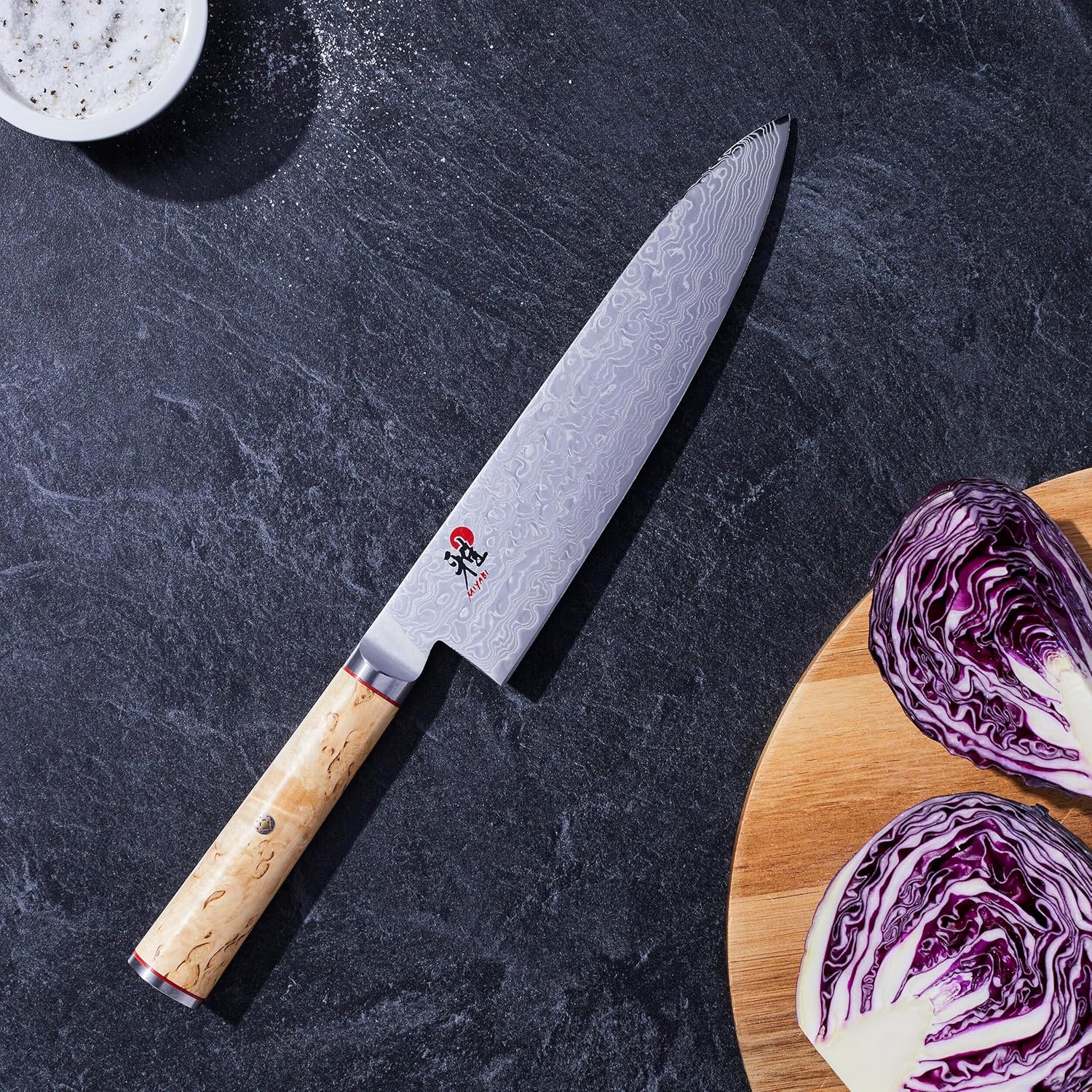
Miyabi Birchwood SG2 has a wa-style handle — the traditional Japanese octagonal or D-shaped wooden handle that attaches at a tang rather than sandwiching it between two slabs. Specifically, it uses Karelian birchwood, a curly-grained birch burl that’s stabilized for moisture resistance and visual drama. The handle is light, and the balance point shifts noticeably forward toward the blade.
Owners across aggregated reviews consistently describe this as feeling like a precision instrument: the knife “wants” to move. For someone who already understands pinch grip (holding the blade between thumb and forefinger just ahead of the bolster), this forward balance is deeply satisfying. For someone still transitioning from a Western-handle knife, it can feel like driving a sports car after years in a sedan — exciting, but requiring conscious adjustment before it becomes instinct.
The aesthetic of the birchwood handle generates some of the most enthusiastic gift-opening reactions of any production knife in this price class. It is genuinely one of the most beautiful objects in Seki City’s output at production scale.
Miyabi
$364.95
In stock on Amazon
Check price on AmazonShun Premier: The Hybrid Handle That Meets You Where You Are
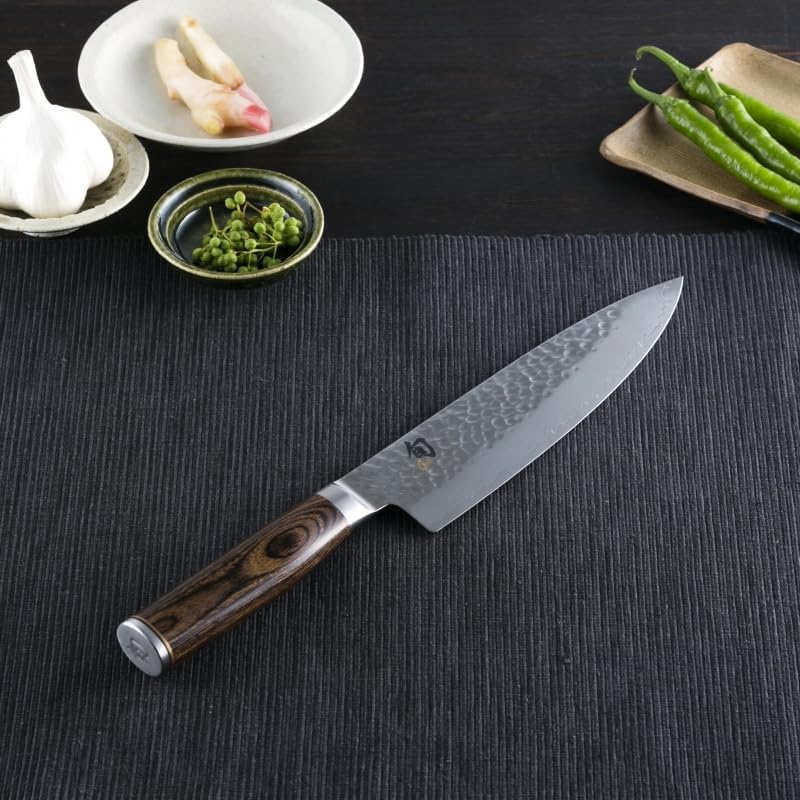
Shun Premier takes a different approach. It uses a walnut-finished PakkaWood handle (resin-impregnated wood composite) in a D-shape that’s slightly more ergonomic and familiar than a full octagonal wa handle. Wirecutter’s “The Best Chef’s Knife” review has repeatedly praised the Shun Premier’s handle as unusually comfortable for long prep sessions, noting that it accommodates the transition from Western knives without forcing an immediate rethinking of grip mechanics.
The hammered tsuchime finish on the blade — those small divots visible across the upper flat — is worth noting separately. It reduces the surface area in contact with food during slicing, which helps wet vegetables and proteins release from the blade rather than sticking. The balance on the Shun is more centered, closer to what a Western-trained cook expects. That’s not a limitation; it’s a deliberate design choice that makes the knife immediately usable rather than aspirational.
Wirecutter’s chef’s knife coverage specifically calls out the Shun Premier’s combination of handle comfort and blade release properties as making it one of the most accessible Japanese-style knives for cooks still building their technique.
Shun
$219.95
In stock on Amazon
Check price on AmazonBy the Numbers
| Feature | Miyabi Birchwood SG2 (8” chef) | Shun Premier (8” chef) |
|---|---|---|
| Core steel | SG2 (R2) powder steel | VG10 stainless |
| Hardness (HRC) | 62–64 | 60–61 |
| Damascus layers | 101 | 68 |
| Handle style | Wa (Karelian birchwood) | Hybrid D (PakkaWood walnut) |
| Blade finish | Mirror-polished spine, fluted | Hammered tsuchime |
| Typical street price (2026) | $300–$380 | $195–$260 |
| Country of manufacture | Seki City, Japan | Seki City, Japan |
Both knives are made in Seki, Japan’s historic knife-making capital. Saveur’s “A Guide to Japanese Kitchen Knives” notes that Seki’s blade-forging tradition stretches back more than 800 years, rooted in samurai sword production — a lineage that shaped the metallurgical culture still operating in the city’s modern factories. That heritage is part of what you’re giving when you choose either knife.
What Reviewers and Long-Term Owners Actually Say
The Miyabi Birchwood SG2 Over Time
Pulling patterns from Serious Eats’ Japanese knife guide and Food & Wine’s “Best Japanese Knives, Tested and Reviewed” (2025):
Miyabi Birchwood SG2 owners consistently highlight edge retention as the standout quality — many report going months of regular home use between sharpenings when maintaining the edge with a ceramic honing rod. The consistent caution across reviews mirrors the steel science: avoid hard frozen foods, don’t use it on bones, and store it on a magnetic strip or in a blade guard rather than loose in a drawer. The edge geometry at approximately 9–12 degrees per side is acute enough that lateral stress is the enemy.
Food & Wine’s tested roundup places the Miyabi Birchwood SG2 among its top recommendations for experienced home cooks and culinary professionals who want a knife that performs at the level of custom-made blades without the multi-month wait and four-figure price of true artisan work.
Miyabi
$364.95
In stock on Amazon
Check price on AmazonThe Shun Premier Over Time
Shun Premier owners consistently emphasize integration speed — less of a “learning adjustment” and more of a direct upgrade from whatever they were using before. The hammered finish earns consistent praise in real prep sessions: slicing cucumbers, fennel, and proteins with minimal drag or sticking. Several long-run reviewers in Food & Wine’s coverage note the Shun holds up well to high-frequency daily use in genuinely busy home kitchens.
The framing that surfaces occasionally in enthusiast knife communities — that VG10 is “the premium choice for people who aren’t obsessed with knives” — is meant affectionately and is worth passing along honestly. It’s an acknowledgment that the Shun Premier is exceptionally well-calibrated for the cook who wants a serious tool without needing to study metallurgy to feel good about owning it. That’s a real category of person, and the Shun Premier serves them better than anything else at this price.
Shun
$219.95
In stock on Amazon
Check price on AmazonThe Gift Decision: A Practical Frame
If You’re Buying for an Experienced Japanese-Knife Cook
→ Miyabi Birchwood SG2. The SG2 steel, the birchwood wa handle, and the 101-layer Damascus finish combine into an object that reads as “heirloom” rather than “nice kitchen tool.” It will be the knife they reach for when something matters — a dinner party, a celebratory meal, a moment when the food deserves the best tool available. Budget $330–$380 for the 8-inch chef’s knife.
Miyabi
$364.95
In stock on Amazon
Check price on AmazonIf You’re Buying for Someone Getting Their First Serious Japanese Knife
→ Shun Premier. The centered balance, the hybrid handle, and the forgiving VG10 steel make it the better introduction to what Japanese knives actually feel like in daily use. At $200–$250 for the 8-inch chef’s knife or the santoku, it’s also the more accessible splurge. Food & Wine’s reviewers have called it “the easiest recommendation in the premium Japanese category” — that’s not faint praise; it’s an acknowledgment of how well the total package is calibrated for someone arriving from Western-knife cooking.
Shun
$219.95
In stock on Amazon
Check price on AmazonIf You Want to Give a Paired Set
→ Start with the Shun Premier santoku (shorter, flatter blade profile — ideal for the push-chop motion most home cooks actually use for vegetables) and add the Miyabi Birchwood SG2 in a longer chef’s knife or gyuto profile. The two steels and handle styles complement each other across cutting tasks, and the pairing covers the full range of what a serious home cook reaches for in a given week.
Miyabi
$364.95
In stock on Amazon
Check price on AmazonA Note on Presentation and Care
At this price point, packaging matters. The Miyabi Birchwood arrives in a well-designed gift box that feels intentional; the Shun Premier ships in clean presentation packaging. If you’re giving either as a significant gift, pair it with a proper storage solution — a quality magnetic wall strip or a wood knife block — and a brief note recommending hand-washing only. Dishwashers are the silent enemy of high-hardness Japanese steel: the thermal cycling, the caustic detergents, and the rattling contact with other items all degrade both the edge and the handle over time.
Both knives represent the best of what Seki’s production knife industry can deliver at scale — factories staffed by craftspeople with decades of blade-grinding experience, working alongside increasingly sophisticated powder metallurgy. Neither is a hand-forged honyaki (a single-steel artisan blade that starts around $800), but both are made with enough precision and care that they’ll outlast most kitchens they enter. That’s what premium means here: not the highest possible specification, but the best version of a tool you’ll actually use and keep.
The Miyabi name itself references the Japanese aesthetic concept of miyabi — courtly elegance and refinement. Shun takes its name from the Japanese concept of peak seasonal ripeness: the exact moment when an ingredient is at its best. Those stories are part of what you’re giving. Both of them hold up.