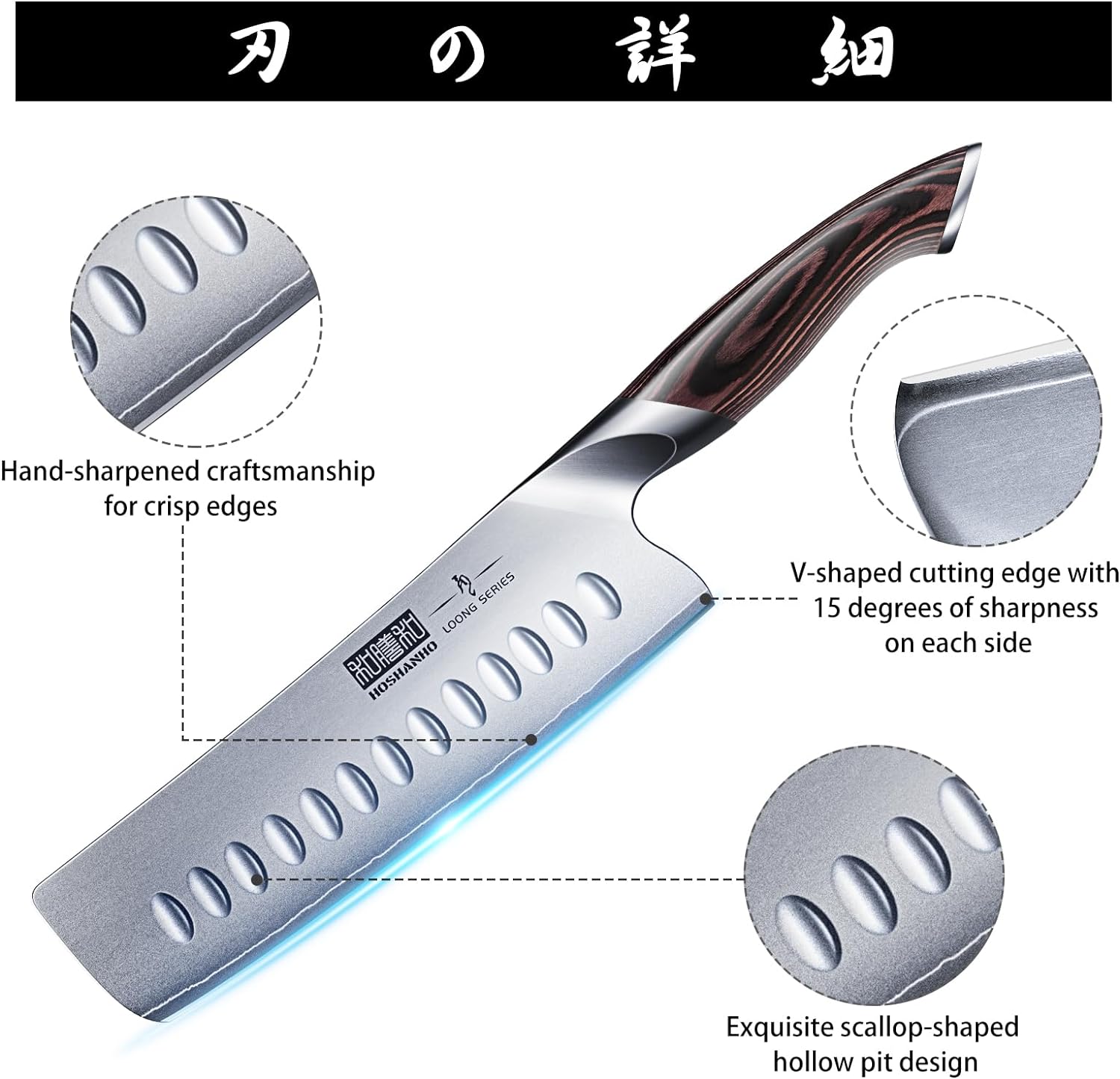
The Nakiri Knife: Japan’s Dedicated Vegetable Blade and Why It Changes Prep Forever
If you’ve ever watched a Japanese home cook move through a pile of cabbage, daikon, or eggplant with unnerving speed and precision, there’s a good chance the knife in their hand had a flat, rectangular blade with a blunt tip — almost nothing like the curved, pointed chef’s knife you probably keep on your counter. That tool is called a nakiri (pronounced nah-KEE-ree), which translates roughly from Japanese as “vegetable cutter.” It’s a knife designed from the ground up to do exactly one thing: break down vegetables with minimal effort and maximum control. This guide explains what makes the nakiri different, what you give up by specializing, and how to figure out whether it’s your next smart buy or a niche addition you don’t actually need yet.
| EDITOR'S PICK[MITSUMOTO SAKARI 4-Piece Japane…](https://www.amazon.com/dp/B0D31NBLH2?tag=greenflower20-20) | Mid-tierPAUDIN Nakiri Knife - 7" Razor… | Budget pick[HOSHANHO 7 Inch Nakiri Knife](https://www.amazon.com/dp/B0FZH3R4XJ?tag=greenflower20-20) | |
|---|---|---|---|
| Blade length | — | 7" | 7" |
| Steel type | San-Mai 9Cr18MoV | High Carbon Stainless Steel | Japanese High Carbon Stainless Steel |
| Handle material | Rosewood | — | Pakkawood |
| Includes box | ✓ | — | — |
| Knife types | 4-piece set | Nakiri only | Nakiri only |
| Price | $176.39 | $43.99 | $33.24 |
| See on Amazon → | See on Amazon → | See on Amazon → |
What Makes a Nakiri Different From What You Already Own
The defining feature of a nakiri is its blade geometry — specifically, the near-flat cutting edge that runs almost parallel to the cutting board along its entire length.
Most Western chef’s knives have a pronounced belly (a curved arc on the cutting edge). That curve is great for the rocking chop technique — you keep the tip planted and rock the heel down through an herb or shallot. It’s fast, intuitive, and extremely versatile. But that curve has a tradeoff: when the blade rocks, only part of the edge makes contact with the food at any given moment. On soft or layered vegetables — think leeks, napa cabbage, or zucchini — you get small tears at the end of each stroke because the blade exits at an angle rather than completing a clean, full push-cut.
The nakiri solves this with a straight edge that contacts the full length of the cut in one downward push. No rocking required. The result, as Toiro Life’s Japanese Kitchen Knives 101 guide describes it, is “a clean, press-and-lift motion that produces uniform slices without dragging or tearing fragile cell walls.” That matters more than it sounds: bruised cell walls release moisture faster, which is why your cucumber salad turns watery, your herbs go limp, or your stir-fry vegetables steam instead of sear.
The other key difference: the blade height. A nakiri blade is typically 45–55 mm tall (roughly 1.75–2.2 inches), which is noticeably deeper than most chef’s knives. That extra height gives you a natural knuckle clearance — your fingers curl naturally on the food and stay well above the board — and doubles as a wide, flat transfer tool for scooping ingredients from board to pan.
What it isn’t: The nakiri is not the nakiri’s professional-kitchen cousin, the usuba. As Knife Planet’s breakdown of the two knives explains, the usuba is a single-bevel blade (sharpened on one side only) used by trained Japanese chefs for decorative cuts and extremely fine work. The nakiri is double-bevel — sharpened symmetrically on both sides, just like a Western knife — which makes it far more forgiving to maintain and suitable for right- or left-handed use without special ordering.
The Tradeoffs You Need to Name Before You Buy
Specialization always costs something. Here’s the honest accounting:
What you gain:
- Push-cutting and pull-cutting vegetables with zero tearing on soft produce
- Cleaner cuts on hard roots (carrots, burdock, winter squash) because the tall blade distributes force evenly
- Intuitive knuckle clearance for high-volume prep
- A lighter, thinner blade profile than most chef’s knives at the same price — less fatigue on long prep sessions
What you give up:
- Protein work. The flat edge and thin spine make the nakiri a poor choice for breaking down chicken, portioning fish, or any task that involves sinew or bone. It’s not designed for it, and using it that way risks chipping a thin Japanese edge.
- Tip work. There is no pointed tip, so fine mincing and detail cutting (deveining shrimp, scoring fish skin) go back to your chef’s knife or a paring knife.
- Rock-chopping speed on herbs and aromatics. If your muscle memory is fully committed to the rocking technique, the flat edge will feel unnatural for a few weeks.
The honest verdict: If you already own a solid chef’s knife and find yourself doing substantial vegetable prep — weekly meal prep, plant-forward cooking, Japanese or East Asian cuisine at home — the nakiri is a meaningful upgrade, not a duplicate. If you’re still building your first knife set, get a reliable 210 mm gyuto (the Japanese chef’s knife) first and return to the nakiri when you know your prep habits well enough to justify a specialist.
Wirecutter’s chef’s knife guide makes this point clearly in the context of Japanese blades generally: “A specialized knife earns its place on the counter when you can name a weekly task it does better than your current tool.”
By the Numbers
| Category | Entry Nakiri | Mid-Range | Premium / Artisan |
|---|---|---|---|
| Typical price (2026) | $60–$120 | $150–$300 | $350–$800+ |
| Steel type | Stainless (e.g., VG-10, AUS-8) | Semi-stainless, powder steel | Carbon or Honyaki |
| Edge retention | Good | Very good | Exceptional |
| Maintenance difficulty | Low | Moderate | High |
| Right for | First nakiri, high-volume home use | Serious home cook, gift | Collector, professional |
How to Read Steel and Grind Specs at This Price Level
Once you move past the $100 mark, you’re shopping steel types and grind profiles — and the differences are real.
Steel: The majority of mid-range nakiri knives use VG-10 or AUS-10 stainless steel, both of which reviewers and spec sheets consistently describe as a practical balance between edge retention and ease of maintenance. You can touch up a VG-10 nakiri on a ceramic honing rod and sharpen it yourself on a 1000/3000 whetstone without advanced technique. Serious Eats’ nakiri roundup notes that VG-10 blades “hold an edge well through weeks of regular home use before needing a full sharpen.”
Step up to SG2 or R2 powder steel (common in the $200–$400 range from makers like Miyabi, MAC, and Yoshihiro) and you get noticeably finer edge geometry — these steels take a more acute angle and hold it longer — but they’re also more brittle. Owners consistently report that powder-steel blades chip if used carelessly on hard squash with a sideways twist rather than a straight push-cut. The technique discipline the nakiri demands becomes more important, not less, as you move up in steel quality.
Carbon steel nakiri: At the premium end, hand-forged carbon-steel nakiris from regional smiths (Sakai and Tosa are the two major production centers) develop a patina — a surface oxidation layer — with use. The Japan Times has covered Sakai’s blade-making tradition extensively, noting that Sakai accounts for roughly 90% of Japan’s professional single-bevel knife production and a significant share of its premium double-bevel output. Carbon steel takes a sharper initial edge than stainless and is preferred by professionals for that reason, but it requires drying after every use and periodic light oiling. If you’re not willing to add that step to your workflow, stay with stainless.
Blade grind: Look for a flat grind or hollow grind (also called a concave grind). A flat grind means the blade tapers evenly from spine to edge — food releases cleanly without sticking. A hollow grind creates a slight concavity that further reduces drag on sticky vegetables like potato or taro. Cook’s Illustrated notes in their knife-skills coverage that “food release on a nakiri is noticeably better with a hollow-ground blade on high-starch vegetables.”
Matching the Knife to Your Actual Kitchen
The decision isn’t just about specs. It’s about fit.
If you meal prep 3+ times a week and cook plant-forward: The nakiri pays back its cost in time and wrist fatigue within the first month. Look at the mid-range stainless tier — makers like Tojiro’s DP series or MAC’s Professional line consistently appear at the top of aggregated review rankings for this use case, offering forged construction and thin-ground edges at $120–$180.
If you’re buying as a gift for a serious home cook: The nakiri is one of the best gateway gifts into Japanese knife culture precisely because it’s immediately legible — anyone can feel the difference on their first head of cabbage. A mid-range nakiri ($150–$250) from a named maker (Yoshihiro, Shun, Global) in a fitted wooden box reads as a considered, premium gift. Toiro Life’s gift-guide context makes this point: the nakiri is “one of the few specialty knives a home cook will use almost immediately rather than admiring from a distance.”
If you’re a semi-professional or private dining chef evaluating a blade upgrade: You’re probably past the entry tier. The honest question is carbon vs. stainless — which maps directly to how much knife maintenance is built into your workflow. If you have a weekly sharpening habit and respect for reactive steel, a Sakai-made carbon nakiri in the $300–$500 range is a meaningful professional tool. If your sharpening is occasional and you cook in a high-humidity environment, a premium stainless (R2/SG2) at the same price is the more durable daily choice.
If you’re a collector: The nakiri’s rectangular blade face is a natural canvas for the blacksmith’s finish. Kurouchi (a dark, forge-scale finish left intentionally on the upper blade) and tsuchime (hand-hammered dimple texture) finishes at the $400–$800 tier are objects worth displaying. At this level, you’re also choosing a handle style — a traditional wa-handle (octagonal or D-shaped, in magnolia or ebony) versus a Western-style riveted handle — as much as a steel specification.
The Clear Decision Rule
Run through this before you buy:
- “I cook mostly meat and fish, vegetables are incidental.” → Not your knife. Invest in a better gyuto or a honesuki boning knife first.
- “I do heavy vegetable prep at least twice a week and my chef’s knife feels clumsy on it.” → A mid-range nakiri at $120–$200 is a direct upgrade with a short adjustment curve.
- “I want to give a knife as a serious gift to someone who already owns a chef’s knife.” → The nakiri is a near-perfect choice: it’s specialized enough to feel deliberate, practical enough to use immediately.
- “I’m ready to invest in a generational blade and I already sharpen on whetstones.” → Move to the carbon-steel or premium powder-steel tier from a named regional smith. Provenance matters here — a knife from Sakai’s traditional district or a named Tosa forge carries a story that compounds the object’s value over time.
The nakiri won’t replace your chef’s knife. It will make you wonder why you ever tried to make your chef’s knife do everything.