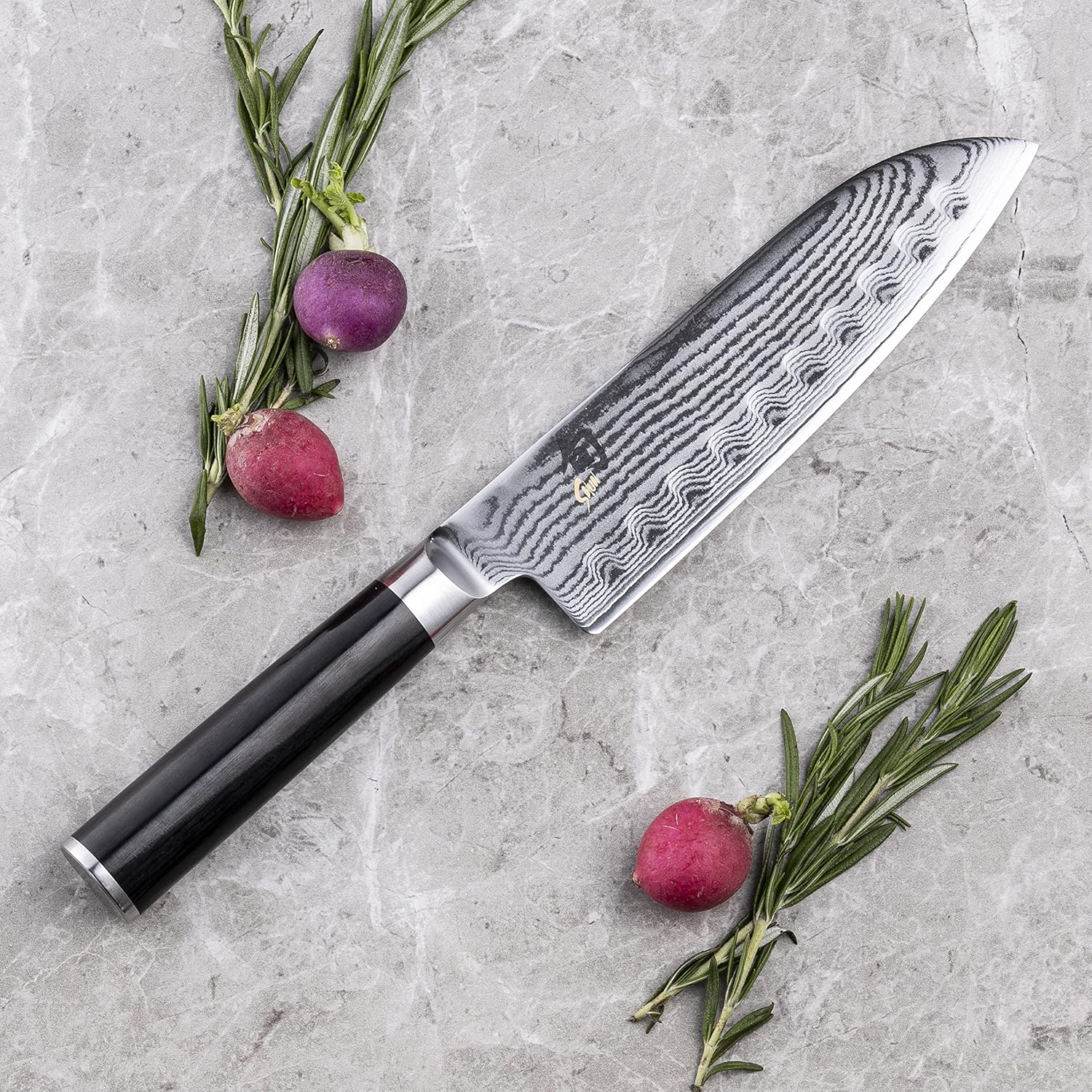
If you’ve ever stood in front of a knife block wondering whether you really need seven different blades — you don’t — the santoku (pronounced “san-TOH-koo”) is probably the answer to that question. The name literally translates to “three virtues” in Japanese, a reference to the three tasks this knife handles elegantly: slicing, dicing, and mincing. It’s shorter and lighter than the classic Western chef’s knife most people grew up watching on cooking shows, with a flatter belly (the curved underside of the blade), a sheep’s-foot tip that curves gently down rather than coming to a sharp point, and a blade length that typically runs between 5 and 7 inches. That’s it. No mystery, no intimidating backstory — just a well-engineered, deeply practical tool that has been Japan’s default home-kitchen knife for decades, and that has earned a devoted following in professional kitchens worldwide.
This guide is for the cook who already has a knife or two, knows what “edge retention” means, and is now trying to decide whether a santoku belongs in their drawer — and if so, which one is worth the money. We’ll break down what makes a santoku different from its closest competitors, where the real tradeoffs live across price tiers, and how to match the right blade to your actual cooking style. By the end, you’ll have a clear decision rule, not just a longer list of options.
What Actually Makes a Santoku Different
To make a smart purchase decision, it helps to understand why the santoku’s geometry produces different results than the knives you may already own.
The flat belly is the key variable. A Western chef’s knife (the broad, slightly curved blade you see in most European and American sets) is designed for a rocking motion — you pivot the blade tip on the cutting board and rock the heel up and down through ingredients. The santoku’s flatter edge is optimized for a push-cut or pull-cut: the blade drops straight down through the food, or moves forward as it descends. The result is cleaner, more controlled cuts with less lateral movement. Knife Planet’s comparison guide notes that this geometry makes the santoku particularly efficient for vegetables and boneless proteins, where precision matters more than speed.
The blade height gives you knuckle clearance. Santoku blades are notably tall relative to their length. That extra height (often called the “blade road”) means your knuckles stay safely above the cutting board when you’re working through a pile of carrots or cabbage. It’s not a small comfort — reviewers across aggregated ratings consistently flag this as one of the reasons the santoku feels more secure to newer cooks than a narrower blade.
The tip shape changes what you can do with it. The sheep’s-foot profile — where the spine curves down to meet the edge at the tip, rather than the edge curving up — means the santoku doesn’t lend itself to the point-pivoting technique, and it won’t pierce or tip-work a whole fish the way a long chef’s knife can. That’s a genuine tradeoff, not a flaw. If you primarily prep vegetables, work with boneless proteins, and do a lot of fine knife work (herb chiffonade, garlic mincing, shallot brunoise), the santoku’s geometry is working for you on every cut.
The steel is often harder. Most Japanese knives, including santoku blades from established makers, are ground from steel hardened to 60 HRC (Rockwell Hardness scale — a measure of how resistant the metal is to deformation) or above. Toiro Life’s knife geometry guide explains that harder steel allows a thinner edge bevel, which is why Japanese blades feel so effortlessly sharp. The tradeoff: harder steel is more brittle, meaning it can chip if you torque the blade sideways or cut through frozen food or bone. You’re trading ruggedness for refinement.
The Price Tiers: Where the Real Differences Live
Here’s the honest shape of the market as of mid-2026.
By the Numbers: Santoku Price Tiers
| Tier | Price Range | What changes |
|---|---|---|
| Entry | $30–$80 | German or Chinese steel, softer HRC (~56–58), thicker grind |
| Mid-range | $80–$200 | Japanese steel (VG-10 common), full or partial bolster, cleaner finish |
| Premium | $200–$400 | High-alloy or Damascus cladding, wa (Japanese) or premium yo (Western) handle |
| Heirloom / Artisan | $400–$1,200+ | Hand-forged, single maker, Honyaki or laminated hagane construction |
Entry tier ($30–$80): These knives are not bad. A Tojiro DP santoku in VG-10 steel — widely cited by Serious Eats and Wirecutter in their respective Japanese knife roundups as one of the best-value blades available — lands in this range and genuinely punches above its price. The grind is thinner than budget German knives, and the edge retention is real. If you’re equipping a first Japanese kitchen and you’re not yet sure how much you’ll lean on this knife, this tier is the right move. You are not compromising on craft heritage here: Tojiro has been making professional-grade blades in Niigata Prefecture’s Sanjo City (a town with centuries of blacksmithing history) since 1955.
Mid-range ($80–$200): This is where the decision gets interesting, and where most practitioners reading this article are probably shopping. Shun’s Classic and Premier lines, MAC’s Professional series, and Global’s G-series all live here. The Shun Premier Damascus santoku — with its hammered tsuchime (hand-hammered) finish and walnut PakkaWood handle — is a genuine aesthetic object, and Food & Wine’s Japanese knife roundup consistently places it among the top picks for home cooks who want something that looks as considered as it performs. Owners report that the thin blade behind the edge makes vegetable prep feel almost effortless. That thinness also means you’ll want to be deliberate about maintenance: a honing rod isn’t appropriate for Japanese steel this hard; a fine ceramic or leather strop is the right tool.
Premium and heirloom ($200–$1,200+): Once you’re above $200, you’re paying for three things: steel composition (high-alloy steels like SG2, ZDP-189, or traditional white and blue carbon steels), hand-finishing, and handle craft. The Yoshihiro Honyaki line — “honyaki” means single-forge, as opposed to the laminated construction of most production knives — represents the apex of this category. Japan Times’ reporting on Japanese knife culture notes that a true honyaki blade requires a master bladesmith’s ability to differential-harden a single piece of steel without warping it, a skill that takes decades to develop. At $600–$1,200 for a santoku in this category, you are buying a piece of culinary craft history. That’s a legitimate reason to spend the money, but not the right reason if you’re primarily looking for a daily-use prep knife.
The Closest Competitors: Santoku vs. Gyuto vs. Nakiri
You likely have other knives in mind. Here’s the honest tradeoff matrix.
Santoku vs. Gyuto (Japanese chef’s knife): The gyuto is the Japanese adaptation of the Western chef’s knife — longer (typically 8–10 inches), with more belly curve and a pointed tip. Knife Planet’s comparison piece puts it plainly: the gyuto gives you more versatility for proteins (the tip is useful, the length handles whole fish and large roasts), while the santoku gives you more control for vegetables and fine work. If you do a lot of protein butchery at home, the gyuto wins. If your cooking skews plant-forward or your cutting board is on the smaller side, the santoku is the better daily driver.
Santoku vs. Nakiri (Japanese vegetable knife): The nakiri is a flat-edged, double-bevel knife designed purely for vegetables — no tip, even taller blade, pure push-cut geometry. It’s exceptional at what it does. But it won’t cleanly slice a chicken breast or mince an anchovy into paste the way a santoku will. The nakiri is a specialist; the santoku is the generalist. If you’re choosing one knife, the santoku wins on breadth.
Handling and Maintenance: What Owners Consistently Get Wrong
Across aggregated reviews on platforms that aggregate verified purchaser feedback, the most common frustration with premium Japanese santoku knives isn’t the knife — it’s the maintenance mismatch.
Don’t use a honing steel. European honing rods (the ribbed steel rod that came with most Western knife sets) work by micro-bending the soft steel edge back into alignment. Japanese steel at 60+ HRC is too hard for that — you’ll chip the edge. Use a fine ceramic honing rod, a leather strop loaded with polishing compound, or a 2,000–6,000 grit whetstone for touch-ups.
The cutting board matters more than most cooks expect. End-grain wood or high-density polyethylene (HDPE) plastic are the right surfaces for a hard Japanese edge. Glass, ceramic, and bamboo (which is technically a grass and is surprisingly hard) will wreck the edge faster than any misuse of the knife itself. Serious Eats’ knife care coverage flags bamboo boards specifically as a common source of premature edge damage.
Wash by hand, dry immediately. This applies to every knife above $50, but it’s worth restating: dishwashers expose blades to heat cycling, harsh detergent, and impact with other utensils. The handle materials on premium Japanese knives — traditional magnolia wood, stabilized wood composites, buffalo horn ferrules — are particularly vulnerable to moisture and heat.
The Decision Rule
If you’ve read this far, here’s the clear frame.
If your cooking is primarily vegetable-forward, your cutting board is standard-sized, and you want one knife that handles 90% of your prep work: a santoku is your knife. Start with the Tojiro DP if you’re budget-conscious and want proven Japanese craft; step up to the Shun Premier Damascus if you want something that’s also a statement piece and gifts beautifully.
If you regularly break down whole proteins, work with large cuts, or your current collection already includes a solid gyuto: the santoku becomes a specialist addition — excellent for herb work, fine dice, and vegetable prep — rather than your primary blade.
If you’re shopping in the $400+ tier: you’re not just buying a kitchen tool; you’re acquiring craft heritage. In that case, provenance should drive the decision as much as geometry. A hand-forged blade from Sanjo City or Sakai, Japan, with a maker’s mark and documented lineage, is the right investment. A mass-produced “artisan-style” blade at a similar price is not.
The santoku earned its name honestly — three virtues, genuinely delivered. It’s one of the most thoughtfully designed knives in any tradition, and the range of quality available across price tiers means there’s a right answer at almost every budget. The work is figuring out which virtue matters most in your kitchen right now.