If you’ve ever eaten rice at a good Japanese restaurant and wondered why yours at home doesn’t quite match it — glossy, each grain separate but tender, almost fragrant — a Zojirushi rice cooker is likely part of the answer. Zojirushi (pronounced zoh-jih-ROO-shee, meaning “elephant mark” in Japanese) is an Osaka-based appliance manufacturer that has been refining rice-cooking technology since 1974. Their machines range from a straightforward plug-and-press model around $80 all the way to induction-heated, pressure-cooking systems that approach $500. The difference isn’t just marketing tiers — the underlying cooking technology genuinely changes the result in your bowl. This guide cuts through the lineup, names the tradeoffs directly, and ends with a clear decision rule so you know exactly which model to buy next.
| EDITOR'S PICK[Zojirushi NS-ZCC10 5-1/2-Cup Ne…](https://www.amazon.com/dp/B00007J5U7?tag=greenflower20-20) | Mid-tier[Zojirushi Micom 3-Cup Compact S…](https://www.amazon.com/dp/B01EVHWNVG?tag=greenflower20-20) | Budget pick[Zojirushi 3 Cup Rice Cooker/Ste…](https://www.amazon.com/dp/B01EVHWNVG?tag=greenflower20-20) | |
|---|---|---|---|
| Capacity | 5.5-Cup | 3-Cup | 3-Cup |
| Cooking Technology | Neuro Fuzzy | Micom | — |
| Retractable Cord | — | ✓ | — |
| Stainless Steel | — | ✓ | — |
| Price | $223.99 | $151.99 | $55.99 |
| See on Amazon → | See on Amazon → | See on Amazon → |
The Technology Stack: What You’re Actually Paying For
Before comparing specific models, it helps to understand the three distinct technology levels Zojirushi uses, because every price jump in their lineup corresponds to a real mechanical difference — not just extra buttons.
Conventional heating is the entry point. A single heating element at the base of the pot cycles on and off to maintain temperature. It works reliably for white rice and is exactly what the entry-level Zojirushi NHS-series budget units use. The result is good rice. It is not transcendent rice.
Fuzzy Logic (Micom) is where Zojirushi made its name. “Micom” stands for microcomputer — a small onboard processor that monitors temperature throughout the cook cycle and adjusts heating in real time. As the Japan Times reported in a feature on how fuzzy logic transformed domestic cooking in Japan, this technology essentially replicated the intuitive adjustments a skilled cook makes by hand, removing most of the variables that cause inconsistency. Fuzzy logic models in the $130–$250 range are the practical sweet spot for most households. They handle white rice, brown rice, sushi rice, porridge, and quick-cook modes with genuine competence.
Induction Heating (IH) + Pressure is the top tier. Instead of a base element, the entire inner pot becomes the heat source through electromagnetic induction — the same principle as an induction cooktop. Heat distribution is dramatically more even, and the inner pot can reach higher temperatures more quickly. When Zojirushi adds pressure cooking on top of IH, it pushes starch gelatinization further, producing rice with a notably different texture — slightly chewier, deeply cooked through. Wirecutter’s updated 2025 rice cooker guide specifically identified the IH pressure models as producing noticeably superior texture compared to standard fuzzy logic units, particularly for short-grain Japanese rice varieties like Koshihikari.
By the numbers:
| Technology | Approx. Price Range | Best For |
|---|---|---|
| Conventional | $50–$80 | College dorms, occasional cooks |
| Fuzzy Logic (Micom) | $130–$250 | Daily home use, most rice types |
| IH (no pressure) | $200–$310 | Enthusiasts, brown rice focus |
| IH + Pressure | $350–$500 | Serious home cooks, Japanese short-grain specialists |
The Models Worth Your Attention
Zojirushi NS-TSC10 / NS-TSC18 — The Everyday Standard
The NS-TSC series is the center of gravity in the Zojirushi lineup. It uses fuzzy logic, holds 5.5 cups (uncooked) in the 10 version and 10 cups in the 18, and comes with separate settings for white rice (regular, softer, harder), sushi rice, mixed rice, porridge, sweet rice, quick cooking, brown rice, and a rinse-free option. Apartment Therapy’s 2025 hands-on review of the Zojirushi rice cooker called this series “the machine we’d recommend to nearly anyone who doesn’t already have a preference.”
The inner pot is nonstick with a triple-layer construction. Owners consistently report the keep-warm function — which can hold rice for up to 12 hours without significant drying or yellowing — as one of the standout practical features for families cooking on irregular schedules.
The tradeoff: Brown rice is decent but not exceptional. The fuzzy logic system does adjust cycle time, but without IH’s even heat distribution, the outer layer of brown rice can be slightly chewier than the center. If brown rice is your primary grain, this is worth noting.
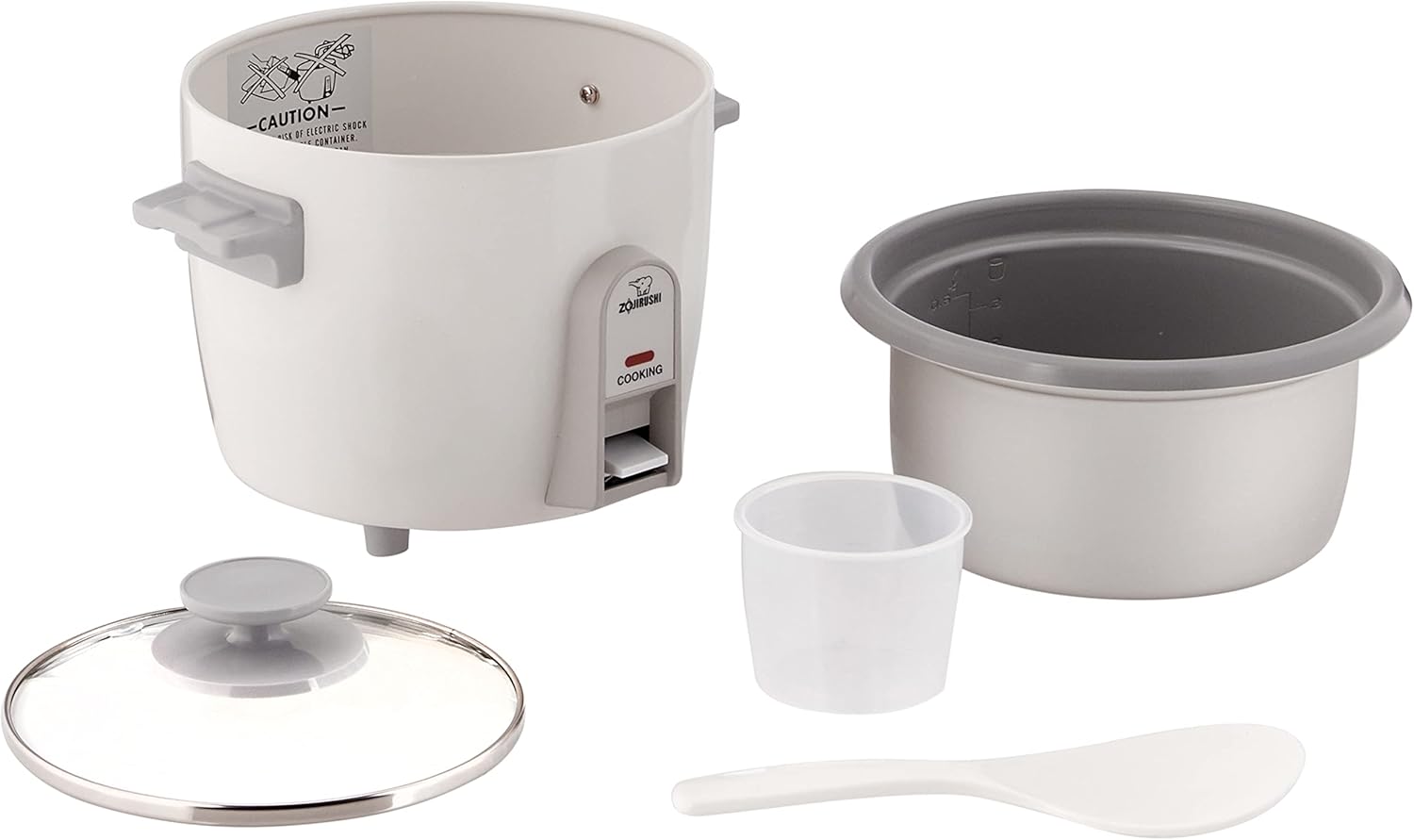
Zojirushi
$55.99
In stock on Amazon
Check price on AmazonZojirushi NS-ZCC10 / NS-ZCC18 — The Slightly Upgraded Daily Driver
The ZCC series adds a few refinements over the TSC: a slightly more robust inner pot coating, a cleaner control interface, and what Zojirushi describes as an improved fuzzy logic algorithm that reportedly shortens cooking time for white rice by a few minutes. The price difference is typically $20–$40 over the TSC depending on retailer and timing.
Serious Eats’ 2025 rice cooker roundup noted the ZCC as marginally more consistent on sushi rice specifically — where you want precise moisture content so the rice absorbs seasoning without becoming mushy. If you’re cooking for guests regularly or treat sushi nights as a genuine ritual, the ZCC is worth the marginal premium over the TSC.
The tradeoff: The functional gap between the ZCC and the TSC is real but narrow for everyday white rice. You’re paying primarily for sushi-rice precision and the slightly more durable pot coating. If neither of those details speaks to your cooking habits, the TSC is the more efficient spend.
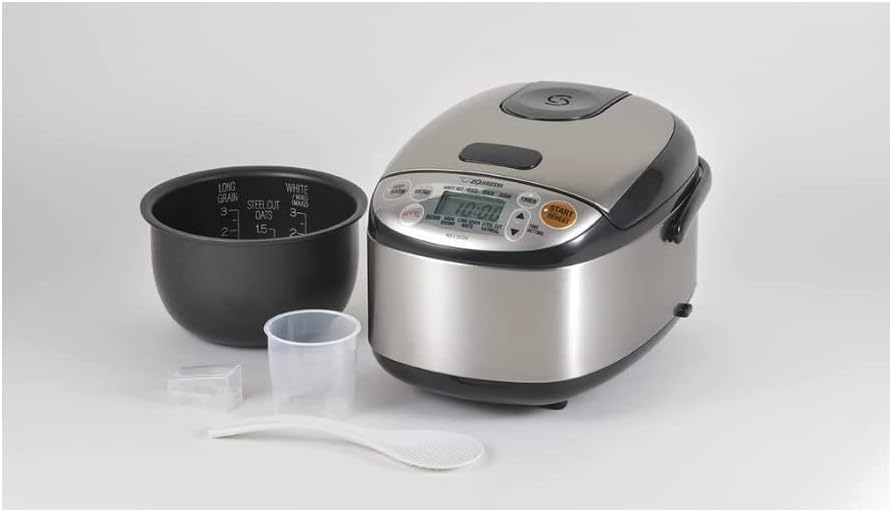
Zojirushi
$151.99
In stock on Amazon
Check price on AmazonZojirushi NW-JEC10 — The IH Step-Up
This is the first model in the lineup where induction heating appears without the pressure component, and it represents a meaningful shift in what the machine can do. The IH element heats the full inner pot surface simultaneously rather than from the base up, which dramatically reduces what engineers describe as the gradient effect — where rice at the bottom of the pot finishes before rice at the top.
Cook’s Illustrated has consistently noted in their rice cooker buying guide that IH models produce more even grain-to-grain moisture distribution across a full pot, which matters most when you’re cooking eight or more cups at a time. For a household of four or a host who regularly feeds a table, this evenness is tangible.
The tradeoff: Price jumps to the $250–$310 range depending on timing. The functional difference over a ZCC for two people cooking three-cup batches is real but modest. This model earns its price when pot size and cooking volume matter.
Zojirushi
$151.99
In stock on Amazon
Check price on AmazonZojirushi NW-HAC10 — The Pressure IH Flagship
The pressure IH models are what Zojirushi positions as their flagship residential machines, and the gap between these and the fuzzy logic units is not subtle once you’re cooking Koshihikari or other premium short-grain Japanese rice. Pressure elevates the boiling point inside the sealed pot to approximately 230°F versus the standard 212°F, accelerating starch gelatinization in a way that produces rice with a distinctly glossier surface and more cohesive bite.
Wirecutter’s 2025 rice cooker guide named the NW-HAC series as the pick for anyone who considers rice a centerpiece dish rather than a side. Serious Eats’ 2025 testing reached a similar conclusion, observing that the texture difference in short-grain Japanese rice cooked under pressure was consistent and significant enough to justify the price for dedicated users. Cook’s Illustrated has also singled out pressure IH cooking as the technology that most closely replicates what a professional Japanese kitchen produces.
The consistent pattern across owner experience is this: people who cook Japanese short-grain rice multiple times per week consider the $400–$500 price point justified within the first year of use. People who cook rice two or three times a week for simpler weeknight meals report that the fuzzy logic machines were sufficient for their needs.
The tradeoff: These are heavier machines — the inner pot alone is substantially more substantial than any fuzzy logic equivalent. Pressure cycles add 10–15 minutes to total cook time. Cleaning the pressure lid and its gasket requires more attention than a standard fuzzy logic model. This is not a set-it-and-ignore-it appliance.
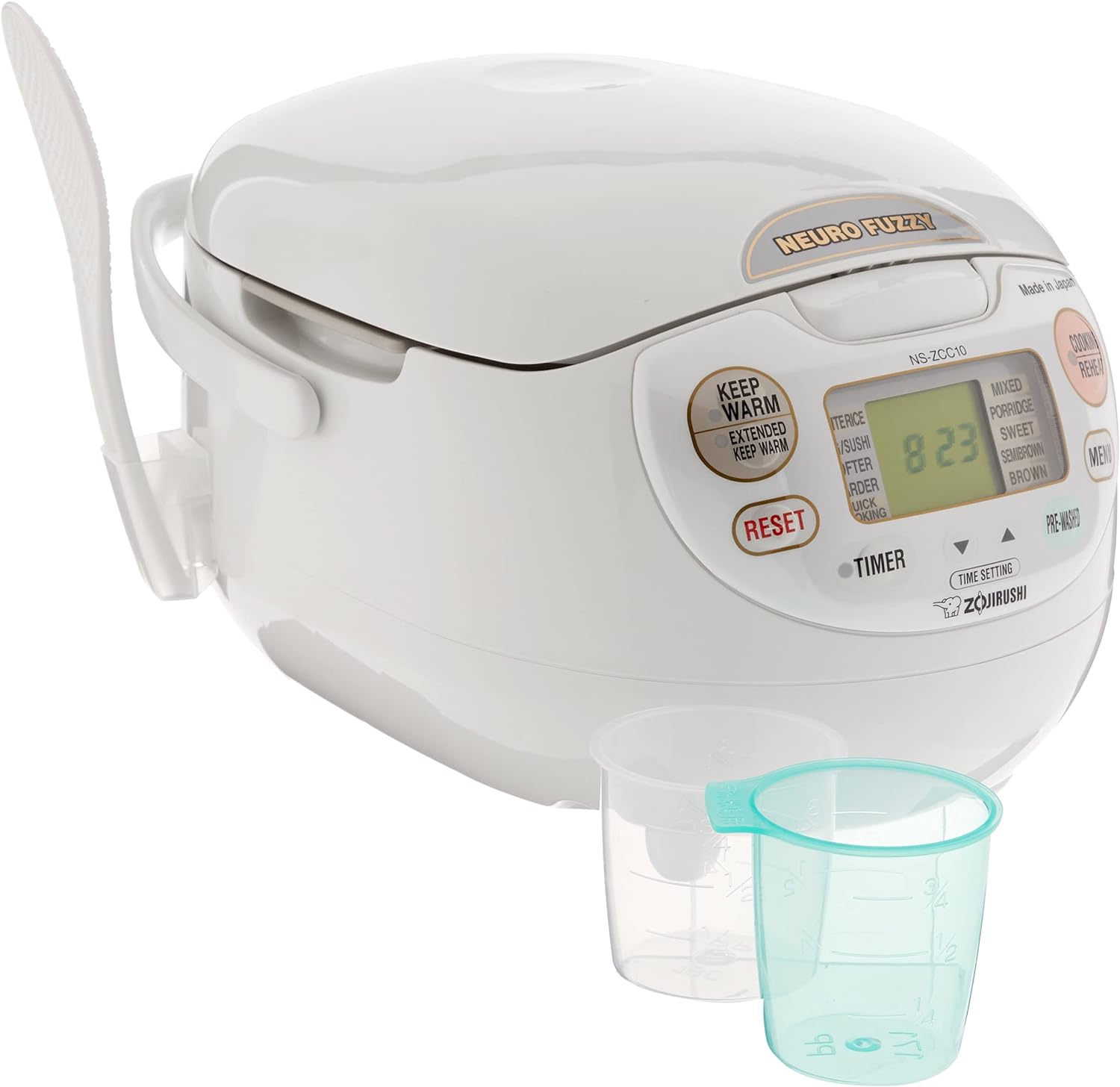
Zojirushi
$223.99
In stock on Amazon
Check price on AmazonThe Decision Frame: If X, Then Y
You’ve read the specs. Here’s how to close the decision.
If you cook rice 2–4 times per week, mostly white rice, for 1–4 people: The NS-TSC10 or NS-ZCC10 is your machine. Spend the $130–$180, own a genuinely great appliance, and direct the savings toward better rice. Koshihikari from a reputable Japanese grocery store will do more for your bowl than upgrading from a TSC to a pressure IH model at this frequency of use.
If you cook regularly for 4–6 people, or sushi rice is a recurring fixture: Move to the NS-ZCC18 for the larger capacity, or the NW-JEC10 if evenness across a full pot matters to you. The IH step-up is defensible here; the pressure premium probably isn’t yet unless short-grain rice is a genuine obsession.
If Japanese short-grain rice is a centerpiece of your cooking — Koshihikari, Sasanishiki, or equivalent — and you’re cooking it at least four or five times a week: The NW-HAC10 pressure IH model is the honest recommendation. The texture difference in premium short-grain rice cooked under pressure is real enough that it shows up consistently across testing at Wirecutter, Serious Eats, and Cook’s Illustrated. The price is real too. Make the call with clear eyes on frequency of use.
If you’re buying as a gift: The NS-TSC10 in the 5.5-cup size is the safest, most universally appreciated choice in the $130–$160 range. It’s the model most owners grow attached to, it comes with Zojirushi’s solid warranty support, and it won’t overwhelm a smaller kitchen. For a serious home cook or culinary school graduate who talks about rice the way collectors talk about knives, stepping up to the NW-JEC10 or even the NW-HAC10 signals that you were paying attention.
A Note on Inner Pot Materials
One underrated variable across the lineup: inner pot construction. Entry-level Zojirushi pots use a single-layer nonstick with an aluminum base. Mid-range fuzzy logic models move to triple-layer construction. The IH and pressure models use a thick-walled pot with a specialized coating that conducts electromagnetic energy efficiently.
This matters in two practical ways: durability and longevity of the nonstick surface. Owners in long-run accounts reported in Apartment Therapy’s 2025 Zojirushi review consistently noted that the IH-model inner pots hold their coating noticeably longer — a factor worth weighing if you’re calculating five-to-seven-year ownership costs. The thicker pots also resist scratching from rice paddles more reliably, which matters if you share a kitchen with someone who reaches for a metal spoon without thinking.
Final Thought on Provenance
Zojirushi machines are designed and engineered in Japan. As of 2026, manufacturing for most consumer-market units destined for North America occurs in facilities outside Japan, a point some purists flag — but the design specifications, quality standards, and proprietary fuzzy logic and IH algorithms remain Japanese-origin intellectual property. The performance record across every major independent review source — Wirecutter, Serious Eats, Cook’s Illustrated, and Apartment Therapy among them — reflects that lineage consistently. You’re buying a machine with genuine craft heritage behind it, at a price point that makes it accessible rather than precious. That’s a combination worth respecting.